Most people treat custom patches as a design decision. They focus on the artwork, choose a shape, approve the colour proof, and place the order without considering how the patch will perform in real use.
The problem usually appears after delivery. The backing may fail, edges can start to fray, and colours may fade after a few washes. What looked “perfect” on screen often does not perform the same way on fabric.
This happens because most buyers evaluate patches visually rather than functionally. Factors like material type, backing choice, border finish, and application method all affect long-term durability.
This guide breaks down everything you need to know about custom patches. From types and backings to borders and real-world use, so you don’t just get a good-looking design but a patch that actually lasts.
What You Are Really Buying When You Order Custom Patches
When you place an order for custom made patches, you buy far more than a piece of fabric with a design on it. You buy a combination of material, backing, border construction, and thread quality that together determine how the patch holds up through months or years of actual use.
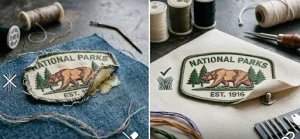
Cheap patches cut corners in ways that rarely show up in a product photo. The base fabric uses a thinner weave that holds stitching loosely. The thread count drops below the density needed to maintain colour saturation after washing. The backing uses a minimal adhesive layer that fails within a few wash cycles. The border uses a lighter overlock that frays at the edge within weeks of regular wear.
Premium custom patches approach every one of those elements as a quality decision rather than a cost variable. The base fabric supports the stitch density the design requires. The thread holds colour through repeated washing because the fibre quality actually warrants it. The backing suits the specific fabric and use case the patch was designed for.
Why Custom Patches Are More Than Just Decoration
Custom patches may look small, but they carry significant meaning. A well-designed patch on a uniform communicates that the organisation values identity, structure, and professionalism. It becomes a visual marker of credibility without saying a word.
For businesses, patches quietly become a branding tool. When they are placed on staff uniforms, jackets, or merchandise, they create consistency at every customer interaction without saying a single word. What looks like a simple design detail is actually repeated brand exposure in real life.
The same applies to schools, sports clubs, and organisations. Custom patches help create identity and unity. On uniforms or team kits, they don’t just look good, they make people feel like they belong to something structured and recognised.
Tip:
Mention that a high-quality, unique patch (like a 3D PVC or complex embroidered design) often acts as a “passive icebreaker,” encouraging customers to ask about the organization or brand history.
Types of Custom Patches and When to Use Each One
Patch are used on military uniforms, organizations, bikers, and many other groups. So do they all have the same type of patch? Actually, no. Patches are made from different materials and come with different backing options. The need depends on what type is ideal for your specific use. Below, we have listed all the types of custom patches you can look for based on your use.
Custom Embroidered Patches (Classic Uniform Use)
Run your hand over an embroidered patch and you feel it immediately. The threads sit slightly raised above the surface. The texture is real and the quality shows before anyone reads a single word on the design.
Custom embroidered patches are the most recognised patch type in the world. Schools, police departments, sports teams, corporations, and military units all reach for embroidered patches. Because they are durable and stylish.
Pros
- Strong, classic appearance that feels premium and professional
- Works very well for uniforms and formal branding
- Durable stitching that holds up well in regular use
- Timeless style that doesn’t go out of trend easily
- Good option for logos and simple to medium-detail designs
Cons
- Not ideal for very detailed or small text designs
- Limited colour blending compared to printed patches
- Can feel slightly heavy or bulky on lightweight fabrics
- Production can take longer compared to simpler patch types
- Less suited for photo-like or highly complex artwork
PVC Patches (Outdoor and Tactical Use)
Every patch comes with a very obvious precaution “protect if from water”. This may seem normal, but people who work on sites, in construction areas, or even sports persons may not be able to protect the patch properly from harsh conditions. For them, custom PVC patches are the best option.
They are made from polyvinyl chloride, which looks like plastic or rubber. They flows of the water instead of getting absorbed. Because of this, they perform well in rough and wet environments. They are not only functional but also their three-dimensional design makes them stylish as well.
Pros
- Fully waterproof and weather resistant by material nature
- Bold three-dimensional surface creates instant visual impact
- Handles mud, salt water, UV exposure, and physical abrasion
- Wipes clean without washing or special care
- Holds colour and shape through years of outdoor use
Cons
- Fine text and intricate detail get lost in the mould
- Feels stiff against soft or lightweight fabrics
- Custom mould creation adds upfront setup cost
- Too rigid in appearance for formal or traditional uniform use
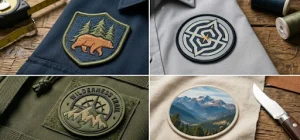
Woven Patches (High Detail Designs)
The definition of the best patch is always that the design is easy to understand in one go. If we talk about embroidery patches, they do well, they are durable and stylish too. But when it comes to very high detailing, the letters start blurring and become hard to read.
For this condition, custom woven patches work well. In this, finer thread construction is used on a closer base weave than embroidery, which allows the reproduction of finer detail, smaller text, and more complex design elements even at smaller patch sizes.
Pros
- Excellent for small text and fine details
- Clean and sharp design appearance
- Works well for complex logos
- Lightweight and flexible
- Better clarity than embroidery in detailed designs
Cons
- Lacks the raised texture of embroidered patches
- Less “premium feel” for traditional uniform use
- Slightly less durable than thick embroidery
- Not ideal for bold, textured designs
- Can look flat from a distance
Printed Patches (Complex Graphics)
Sometimes we need the patch design to look polished, shiny, and exactly the same as it appears in the image. To achieve this, the customized printed option is the way to go. Instead of using machine-crafted threads to create the design, printed patches use digital or screen printing to produce the design on a plain patch fabric.
Mostly, promotional patches carrying complex brand graphics use this technique. It reproduces intricate artwork, and designs with multiple colours benefit the most from printed construction. Businesses and organisations that need consistent colour reproduction across designs with many tonal variations find that printed patches deliver the accuracy that embroidery and weaving cannot.
Pros
- Supports full-colour and photographic designs
- Perfect for gradients and complex artwork
- High accuracy in colour reproduction
- Smooth surface with clean finish
- Ideal for promotional and branding use
Cons
- Less durable than embroidered or PVC patches
- Colours may fade over time with heavy washing
- No raised texture or dimensional feel
- Not ideal for rugged or outdoor use
- Can look less premium compared to stitched patches
Why Patch Material Decides Everything (Not Just Design)
Nobody wants a patch that just looks good but cannot be used a second time. Hopefully, you don’t want that either. However, if you ignore the fabric on which the thread stich on, you’ll end up with a patch that looks great on day one but has a very short lifespan.
Below are the main patch materials and where they work best
| Fabric Type | Best Use Case | Durability | Key Advantage | Limitation |
| Embroidered Patches | Uniforms, formal wear | High | Premium stitched look | Limited detail for small text |
| PVC Patches | Outdoor, tactical, sports | Very High | Waterproof and highly durable | Less traditional appearance |
| Woven Patches | Detailed logos, small text | Medium–High | Sharp detail and clarity | Flat look, less texture |
| Leather Patches | Premium branding, fashion | High | Unique and high-end aesthetic | Limited colour options |
| Chenille Patches | Decorative, varsity patches | Medium | Bold, textured, eye-catching | Not suitable for heavy-duty use |
Types of Backings Explained (And Why Most Patches Fail Here)
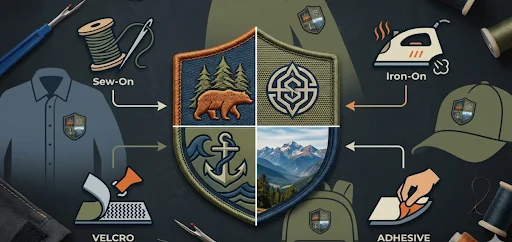
Some patches stick with glue, others have a sew-on option, and some come with Velcro. Each varies based on your need and the type of fabric surface you are using.
For example, you cannot go for an iron-on patch on nylon because it may scorch or damage the surface. So the choice of backing is not just about convenience, it directly affects how well the patch holds and how safe it is for the fabric.
If you also want to find the right backing type for your custom patch, look below.
- Sew-On Backing: This is the most reliable option. It is stitched directly into the fabric, so it holds strong even after multiple washes. Best for uniforms, workwear, and long-term use.
- Iron-On Backing: This uses heat-activated glue to stick the patch onto fabric. It is quick and easy, but not ideal for heat-sensitive fabrics like nylon. Works best on cotton and denim.
- Velcro (Hook & Loop): This allows you to remove and reuse patches easily. Common in tactical gear, uniforms, and situations where patches need to be changed often.
- Adhesive (Peel-and-Stick): This is for temporary use. You just peel and stick, no heat or sewing needed. Good for events or short-term applications, but not very durable.
- Heat-Press Backing: Similar to iron-on but done with professional machines. It gives a stronger bond than a regular iron and is used for bulk or commercial applications.
How to Choose the Right Backing for Your Use Case
Backing selection follows logically from the application once you understand what each option delivers. Matching the backing to the real-world demands of the use case prevents the most common and most avoidable form of patch failure.
Uniforms across every industry, from law enforcement to hospitality, healthcare, and trades, need sew-on backing without exception. The wash frequency, physical demands, and institutional permanence of uniform applications require a mechanical stitch bond that holds through everything the garment faces over its full service life.
Branding applications divide between iron-on and sew-on depending on the garment type and wash frequency. Corporate merchandise and branded casual wear with moderate laundering frequency suit iron-on backing when combined with perimeter stitching reinforcement. High-frequency wash garments like staff workwear need sew-on backing regardless of how simple the application feels.
Tactical and operational applications need Velcro backing wherever patch configurations change between roles, deployments, or operational environments. The system gives field users the flexibility to adapt their identification and insignia without permanently committing every patch to a single garment.
Event and promotional applications suit adhesive backing when the patch serves a single occasion and attachment permanence is genuinely unnecessary. Choosing adhesive backing for any application where the patch needs to survive more than one use delivers disappointing results every time.
Where to Place Custom Patches for Maximum Visual Impact
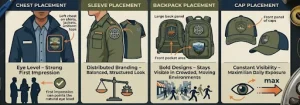
Placement determines how effectively a patch communicates its message, and thoughtful positioning produces significantly stronger visual results than arbitrary placement does.
| Placement Area | Where It Goes | Why It Works | Best Use Case |
| Chest Placement | Left chest on shirts, jackets, uniform tops | Positioned at natural eye level during face-to-face interaction, creating the strongest first impression and clear identification | Uniforms, staff wear, corporate branding |
| Sleeve Placement | Shoulders or upper sleeves (one or both sides) | Distributes branding across the garment and creates a balanced, structured look, especially with both sleeves used | Military, teams, institutional uniforms |
| Backpack Placement | Large back panel or front pocket area | Offers a bigger surface area for bold designs that stay visible in crowded, moving environments | Lifestyle branding, youth markets, merchandise |
| Cap Placement | Front panel of caps | Faces forward with movement, keeping the patch in constant visibility and maximizing daily exposure | Promotions, casual branding, streetwear |
Promotional Uses of Custom Patches in Branding
Personalized emblems are not just used for personal wear or organisations. Many Canadian brands now use this badge-style approach as a promotional asset as well. In modern marketing campaigns, promotional patches are becoming a common tool.
Brands often give them away as part of their campaigns. For the receiver, it feels like a simple style element, something they can easily attach to backpacks, jackets, or shirts. But for the brand, it is a win.
Once the patch is attached, it starts carrying the brand name wherever the person goes. This turns a small design into ongoing brand visibility and awareness without any extra effort.
Tips to Design a Custom Logo Patch That Looks Professional
A professional-looking custom logo patch starts with design decisions that account for the physical realities of patch construction rather than treating the artwork as purely a screen-based exercise.
Readability takes priority over complexity in every effective patch design. The primary text and identifying symbol on the patch need to read clearly at the distance and in the lighting conditions where the patch actually gets seen.
Contrast between the design elements and the background colour produces the visual separation that makes a patch legible across varied lighting conditions.
High contrast combinations, dark backgrounds with light text and symbols, or strong colour pairings between adjacent design zones, maintain readability in the real environments where the patch operates. Low contrast combinations that look acceptable on a backlit screen often flatten into illegibility on a physical patch in natural light.
Border selection frames the design and signals the production quality of the whole piece. A well-specified merrow border on a traditional design, or a clean heat-cut edge on a contemporary one, completes the patch visually and protects it structurally.
For detailed guidance on border options and how they interact with different design styles, exploring how to customise borders for different patch types gives you the specific knowledge to make that decision well.
Frequently Asked Questions
Conclusion
Custom patches reward the buyers who understand what they are actually purchasing and make the material, backing, and design decisions with full knowledge of how those choices affect real-world performance.
The difference between a patch that represents your brand proudly through two or three years of daily wear and one that starts failing before the season ends comes down entirely to those decisions made before production begins.
Patch Makers Canada provides both the production quality and the expert guidance that custom patches demand at every level, from single custom pieces to large institutional runs. Every order receives the same attention to material selection, design compatibility review, backing specification, and production consistency that professional patch buyers expect and deserve.