
Custom embroidered patches have become a defining detail for Canadian businesses, sports teams, fashion brands, nonprofits, and organizations looking to express identity with precision.
But, behind every polished patch is a production process that blends design skill, technical digitizing, and modern embroidery technology. That’s what we’re going to look at, how patches are made from start to finish.
Step 1: Design Concept & Artwork Preparation
The process begins with an idea: usually a logo, emblem, or symbolic graphic.
Customers submit artwork, which is then cleaned up and converted into a production-ready format. Then, designers refine the shapes, adjust proportions for stitching, and determine important details like border style, size, and color palette.
Step 2: Selecting Materials
Material choice shapes both appearance and durability. In Canada, most manufacturers use sturdy fabrics like twill or felt because they can withstand dense stitching and outdoor conditions.
Thread selection also matters: polyester threads offer fade resistance. It is essential for uniforms and outdoor gear, while rayon threads create a more glossy, decorative look.
Step 3: Digitizing the Design
Digitizing is the technical heart of the process. Skilled digitizers translate the artwork into a stitch file that embroidery machines can read.
They choose stitch types, set stitch density, define angles, and map out how each part will be sewn. Good digitizing makes the difference between a crisp, high-definition patch and a messy one. This is one of the areas where Canadian production is known for exceptional precision.
Step 4: Embroidery Production
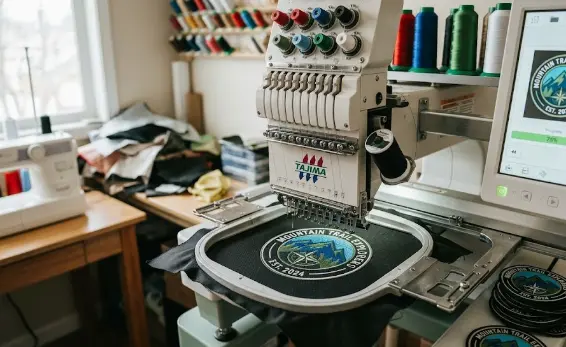
Once the design is digitized, it’s loaded into computerized embroidery machines. Multiple threads operate simultaneously, building the design layer by layer.
Before full production begins, a test run is stitched to check clarity, colour accuracy, and structural integrity. Adjustments are made as needed, then entire batches are produced, whether it’s 10 patches for a local club or thousands for a national brand.
Step 5: Cutting & Finishing
After stitching, patches are cut into their final shapes. Depending on the design, manufacturers use heat cutting, laser cutting, or die cutting for accuracy. Edges are then finished with either a merrowed border, a raised, rounded edge for classic patch styling or a clean satin-stitch edge for complex shapes.
Step 6: Quality Control
Quality control ensures every patch meets uniform standards. Production teams check for thread consistency, edge cleanliness, proper backing adhesion, and colour accuracy. Any patch that doesn’t meet the required standard is removed from the batch.
This step is key to ensuring the reputation of Canadian patch makers, who are often praised for reliability and craftsmanship.
Get Your Style Badged by Patch Makers Canada
At Patch Makers Canada, we turn your ideas into high-quality embroidered patches that look sharp, feel durable, and stand out anywhere you place them. We follow every step of the embroidery process with care, from artwork prep and digitizing to stitching, trimming, and finishing. So your patches come out clean, colourful, and ready to wear.
Whether you’re repping a brand, a team, a club, or just your personal style, we make the process simple. And yes-we proudly accept orders starting at just 10 patches, so you don’t need a huge quantity to bring your design to life.