
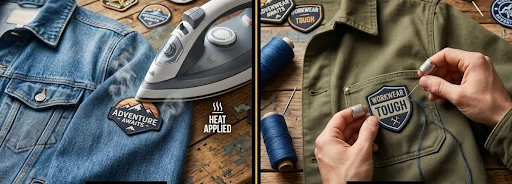
The difference between iron on vs sew on patches comes down to the backing. One only needs heat to apply, while the other needs stitching onto the fabric. The difference sounds simple, but there are other factors that make people compare iron on vs sew on patches before buying.
The “easy” option can fail after a few washes. The “stronger” one can look bulky or unprofessional if it’s not applied properly. So the real decision is not just about application, but about how it performs.
If you also want to know which custom patch is ideal for you then keep reading. In it we break down durability, fabric compatibility, cost over time, and real-world use cases.
Iron-On vs Sew-On Patches: Quick Comparison
Before diving deep, here’s the fast version. Bookmark this. Come back to it.
| Feature | Iron-On Patches | Sew-On Patches |
| Durability | Weakens with repeated washing | Stitching holds through heavy use |
| Ease of Use | No tools needed | Requires needle, thread, or sewing machine |
| Upfront Cost | Lower | Slightly higher (labour or machine time) |
| Cost Over Time | Need replacement | Lasts years without reapplication |
| Best For | Fashion items, light-use garments, quick fixes | Workwear, uniforms, long-term branding |
| Wash Resistance | Heat and detergent degrade adhesive | Holds through industrial washes |
| Reusability | Adhesive is single-use | Can be removed and re-stitched |
What Are Iron-On Patches (And How They Actually Work)
An iron-on patch has an adhesive or glued backing. These backing are mostly made from thermoplastic. To attach these patches onto fabric, you need to apply high temperature. It melts the glue, and then it goes into the fabric surface and holds it tightly.
But that bond has real limits. High heat laundry cycles soften the adhesive again. Stretchy fabrics flex and eventually break the bond at the edges. Nylon, polyester, and synthetic blends often reject the adhesive entirely, or worse, scorch under the required heat.
If you’re looking to apply iron on patch correctly the first time, fabric type is the first variable to get right.
Pros of Iron-On Patches
- Fast application, typically 30 to 60 seconds per patch
- No sewing skills or equipment needed
- Clean, flat finish with no thread showing on reverse
- Great for decorative use on cotton and denim
Cons of Iron-On Patches
- Adhesive degrades with repeated washing and heat
- Does not work reliably on synthetic, waterproof, or textured fabrics
- Cannot be repositioned once bonded
- Edges tend to lift first, especially on garments that flex or stretch
What Are Sew-On Patches (And Why They Last Longer)
Sew on has the plan back. There is nothing on the back of sew-on patches, just a plain simple fabric. You need to stitch them directly onto the garment using thread. The patch itself typically has no adhesive backing.
Thread anchors to fabric in a fundamentally different way than heat adhesive. It doesn’t soften in hot water. It doesn’t react to detergent chemicals. It flexes with the fabric instead of fighting it. That’s the core reason sew-on patches outlast iron-on in almost every high-use situation.
Workwear patches on a trade uniform. Morale patches on a tactical vest. Team logos on a sports jersey. All of these get stitched, because stitching doesn’t quit.
Pros of Sew-On Patches
- Superior long-term durability across all wash conditions
- Works on virtually any fabric including leather, canvas, and nylon
- Can be removed and reattached without damaging the patch
- Professional, clean edge finish when done right
Cons of Sew-On Patches
- Requires more time and skill than ironing
- Thread visible on the inside of the garment
- Higher labour cost if done professionally
- Mistakes during stitching can pucker or distort the garment
Iron-On vs Sew-On Patches: Real-World Differences That Matter
If you want a clearer breakdown that tells you what makes each patch different from the other, read below.
Alt text: factors to consider for choosing custom patches
Durability (Washing, Heat, Wear)
Iron-on patches last around 30 washes. If you are careful and use soft hands, they can remain more than that. In comparison, sew-on patches are stitched with thread, so there is no chance of them coming off even after wash after wash.
Placement also affects the durability of patches. Patches on elbows, knees, shoulders, and bag straps face constant friction. Adhesive backs fail under that pressure. Stitching absorbs it.
Fabric Compatibility (Cotton, Denim, Polyester, Leather)
- Cotton and denim: You can use both iron-on and sew-on patches. Both work fine here.
- Polyester and nylon: These are soft and delicate fabrics. They can’t handle high heat, so iron-on patches are not a good option.
- Leather and faux leather: Leather may not burn easily with heat, but the surface can get tacky and that doesn’t look good. So for leather and faux leather, sew-on is the better option.
- Waterproof and coated fabrics: Since these fabrics have a coating, heat from an iron can damage the surface. In this case, sew-on is the only option.
Application Time & Effort
Iron-on patches need just a matter of minutes to apply on any cloth. As they come with glue, all you need is to apply heat to the patch on the surface of the fabric. Once the glue starts melting, the patch holds the fabric.
In comparison, you need super precision skills and time to stitch sew-on patches. Approximately ten to thirty minutes are needed to attach a sew-on patch to the fabric.
For a quick fix on a kid’s jeans or a decorative badge on a jacket, iron-on wins on time. For a production run of branded uniforms, machine stitching scales efficiently and produces consistent results.
Cost Over Time (Not Just Upfront)
You can attach iron-on patches at home with a household iron. There is no upfront cost for applying iron patches. However, applying sew-on patches needs sewing skill, so if you don’t have it, you may have to pay for stitching costs as well.
When you’re placing bulk orders to make custom patches for a team, business, or brand, the long-term math almost always favours sew-on.
Appearance & Finish
Mostly iron on patches have the flat and sleeky surface whereas sew on patches are made with high surface. The reason the look is the backing. The adhesive backing creates a stiff panel that looks polished from the front.
No thread, no visible stitching, no texture variation. On Sew on patches the stitching adds definition. When done by machine, the finish is crisp and consistent. The reverse side shows thread, which is worth considering on garments where the interior is visible.
When Should You Choose Iron-On Patches?
Iron-on patches are genuinely the right call in specific situations. Here’s when to use them without hesitation.
- Iron-on patches are actually the right choice in some cases. Not always, but in the right situations they do the job well.
- Quick fixes on casual wear. Like a hole in jeans or a worn elbow on a jacket. Iron-on patches cover it fast. On low-stress areas, the hold is usually fine for normal, occasional use.
- Fashion and decorative use. On tote bags, denim jackets, hats, or accessories, patches mostly sit in low-friction areas. The flat, clean look works well here. And since these items aren’t washed too often, durability isn’t a big concern.
- Temporary placement. If you’re not sure about positioning, iron it on first. It lets you test the look before fully committing. Later you can stitch it if you want it permanent.
- Kids’ clothing projects. Quick, simple, and flexible. No sewing skills needed. Kids also outgrow clothes fast, so patches don’t need to last forever anyway.
When Should You Choose Sew-On Patches?
Sew-on patches belong anywhere durability and professionalism matter most.
Workwear and trade uniforms. Construction workers, mechanics, security staff, healthcare teams. Their uniforms get washed hard and worn harder. Stitched patches survive that environment. Adhesive-backed patches don’t.
Sports uniforms and team gear. Jerseys go through sweat, washing, and physical contact every week. Sew-on patches hold through all of it. League logos, player numbers, sponsor badges. All of these demand stitching.
Long-term brand representation. A business putting its logo on staff clothing is making a brand statement. That statement needs to stay put. If you’re looking to design patch for logo use on branded apparel, sew-on is the professional standard. Because it looks the same on day one as it does on day three hundred.
Leather goods and accessories. Jacket backs, bag panels, boots, leather needs stitching. Full stop.
Common Mistakes People Make
These mistakes show up constantly and they’re all avoidable.
- Ironing onto the wrong fabric. Synthetic blends, waterproof coatings, and leather can’t take the heat required for adhesive bonding. The patch won’t adhere properly, or the fabric will be damaged. Always check fabric content before reaching for the iron.
- Not applying enough heat or pressure. A quick press isn’t enough. The adhesive needs sustained heat — typically 15 to 30 seconds of firm, even pressure with a hot iron. Skipping this step means the edges bond poorly and start lifting after the first wash.
- Skipping stitching on high-stress areas. Shoulder patches, sleeve patches, bag strap patches — these face constant friction and movement. Iron-on alone won’t hold. Adding even a simple edge stitch dramatically extends the patch life in these locations.
- Washing immediately after application. The adhesive needs 24 to 48 hours to fully cure. Washing right away weakens the bond before it even gets a chance to set properly.
- Using steam during application. Steam introduces moisture, which interferes with the heat-activated adhesive. Use a dry iron setting only.
FAQs
[faq_accordion]
Get the Right Patch for Your Use Case
Both iron-on and sew-on patches are perfect for gear. The “best” for you depends on your use. If you want a durable and long-lasting patch, then sew-on patches are the better option. But sew-on comes with stitching cost and attachment time. Therefore, for quick attachment, iron-on patches are a good option that looks sleek and can last long if you take proper care of them.
One more important factor that makes the patch life and look better is the thread they are made of. At Patch Makers Canada, we use high-quality thread that stays strong on the base fabric and does not loosen after wear and tear. Also, we offer low minimum order quantities so you can get patches whether for testing or small batches too. So once you get a clear idea of iron-on vs sew-on patches, reach out to us for making and discussing prices.