Custom patches have carried meaning inside the Canadian Armed Forces long before online ordering existed. A regimental crest sewn onto a shoulder tells a story of lineage. A name tape identifies a soldier at a glance.
A qualification badge marks years of training that cannot be faked. Whether the patch belongs to a regular force regiment, a naval division, an air wing, or a reservist unit training on weekends, the small piece of embroidered fabric carries weight that goes far beyond decoration. Today, units, associations, and individual members increasingly order these patches online rather than through slow, paper-based procurement channels.
This guide walks through everything involved in ordering custom embroidered military patches in Canada, from the common patch types worn across the Canadian Armed Forces to the step-by-step online production process, design considerations unique to a bilingual country, and the backing systems that need to work with CADPAT and modern uniform systems.
Military Patches Within Canadian Armed Forces Culture
Patches are not just merchandise inside military circles. They are identity markers tied to regiments, branches, and the smaller reservist units that make up a large share of Canada’s forces. A custom military patch worn on a uniform, a ball cap, or a kit bag communicates rank, unit, qualification, and history in a single glance.
Regiments have long used unit crests to mark their heritage, often tracing back to battle honours and founding dates. Branches such as the Army, Royal Canadian Navy, and Royal Canadian Air Force each maintain their own visual language, with colours, symbols, and mottos that must be reproduced accurately.
Reservist units, training establishments, and cadet organizations also rely on custom embroidered patches to build cohesion among part-time and full-time members alike. Beyond active units, veteran association patches keep this culture alive long after service ends.
Legion branches, regimental associations, and commemorative groups order patches for reunions, memorial events, and everyday wear, preserving connections built during active duty.
Common Patch Types Ordered by Canadian Military Groups
Most custom patch orders placed by Canadian military/law enforcement and veteran organizations fall into a handful of categories. Understanding these categories helps when specifying a design brief.
Unit Crests
Unit crests represent a regiment, squadron, ship, or company. These typically include a shield or crest shape, a Latin or English motto, and symbolic elements tied to the unit’s history. Because these designs are often protected under regimental heraldry guidelines, exact colour matching and proportion accuracy matter more here than with almost any other patch type.
Name Patches
Name patches identify individual members on uniforms. They are usually a simple rectangular patch with embroidered text, produced in bulk for an entire unit roster. Name patches need consistent lettering style, size, and thread colour across every member’s uniform, which makes them a common bulk order for administration officers.
Rank and Qualification Badges
Rank badges and qualification badges mark achievement and responsibility. These patches must follow strict specifications, since they represent officially recognized standing within the Canadian Armed Forces. Stitch precision is critical here, particularly for chevrons, crowns, and small qualification symbols that lose clarity if the digitizing is not handled correctly.
Veteran Association Patches
Veteran association patches commemorate service after release from active duty. These designs often blend a unit’s original crest with additional commemorative text, poppy imagery, or anniversary dates, and they are frequently ordered for reunions or Remembrance Day events.
Step-by-Step Online Ordering Process
Ordering custom embroidered military patches online in Canada follows a consistent production path. Knowing what happens at each stage helps unit administrators, association executives, or individual members plan around production timelines.
Step 1: Upload Artwork
The process begins when a customer uploads existing artwork, a scanned crest, or a rough sketch through the online order form. Even a low-resolution image or a description of colours and symbols is enough to start a custom patch quote, since the design team can rebuild artwork from reference material when official files are not available.
Step 2: Digitizing
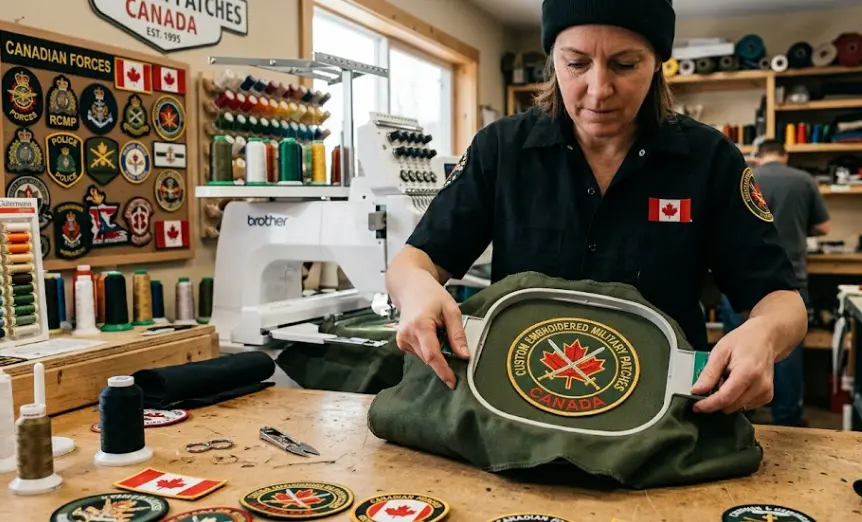
Once artwork is received, it moves into digitizing, the process of converting the design into a stitch file that embroidery machines can read. This step determines how fine detail, small text, and colour transitions will actually appear once stitched. Digitizing is where a two-dimensional image becomes a production-ready embroidery pattern, and it is the stage most responsible for how sharp the finished patch looks.
Step 3: Proof Approval
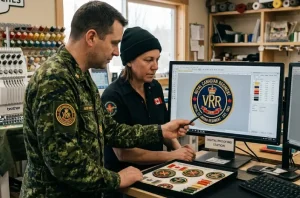
Before any production begins, the customer receives a digital proof showing the exact layout, colours, sizing, and backing option selected. This proof stage is the point to catch any issue with wording, colour accuracy, or motto placement. No production run starts until the customer signs off, which protects against costly reprints on regimentally significant designs.
Step 4: Production
After approval, the order enters production, where embroidery machines stitch the design using the digitized file. Production timelines vary depending on order size and stitch density, and most bulk orders for a full unit roster are completed within a standard turnaround window communicated at the quote stage.
Step 5: Shipping
Finished patches are packaged and shipped from the production facility to the delivery address specified at checkout, with tracking provided so unit administrators can plan distribution ahead of parades, courses, or ceremonies.
Design Tips for Canadian Military Patches
Bilingual Text Considerations
Canada’s status as an officially bilingual country means many military patches need to accommodate both English and French text, particularly for units based in Quebec or for association patches distributed nationally.
Fitting bilingual patch text into a small crest requires careful font sizing and layout planning, since both languages need to remain legible without overcrowding the design. Working with a digitizer experienced in bilingual layouts prevents text from becoming cramped or losing clarity once stitched at actual patch size.
Colour Matching to Official Insignia
Regimental and branch insignia often follow strict colour specifications tied to heraldry standards. Colour matching to official insignia is one of the most important quality checks in the entire process, since a shade that is even slightly off can make a crest look unofficial.
Providing Pantone references, existing patch samples, or official regimental documentation during the artwork upload stage significantly improves colour accuracy in the finished product.
Backing and Attachment Options for CADPAT and Uniform Compatibility
Backing choice determines how a patch attaches to a uniform, and compatibility with CADPAT and other current uniform systems is a common requirement for Canadian military orders.
- Velcro backing allows patches to be moved between uniform items and swapped quickly, which suits units that rotate between garrison order and field kit.
- Sew-on backing provides a permanent attachment method often required for formal dress uniforms and name tapes.
- Iron-on backing offers a fast application method suited to lower-turnover items such as association merchandise or event apparel.
- Merrowed border finishing gives a clean, durable edge that holds up under repeated washing and field conditions.
Choosing the right backing depends on how often the patch will move between uniform items and whether it needs to comply with existing CADPAT-pattern uniform hardware such as hook-and-loop panels already sewn onto the issued kit.
Pricing Factors for Custom Military Patches
Several variables affect the cost of a custom embroidered patch order, and understanding them helps when budgeting for a unit or association purchase.
- Patch size: larger patches require more thread and machine time, increasing per-unit cost.
- Stitch density: highly detailed crests with fine lettering or shading require denser stitching, which raises production cost compared to simpler designs.
- Quantity tiers: ordering in bulk for a full unit roster typically reduces the per-patch price significantly compared to small individual orders.
- Backing selection: Velcro and specialty backings can add a modest cost compared to standard sew-on finishing.
- Colour count: designs with a high number of thread colours take longer to produce and can affect final pricing.
Requesting a custom patch quote with exact quantity, size, and backing requirements up front gives the most accurate pricing before committing to an order.
Shipping Across Canadian Provinces and Territories
Canada’s geography means shipping timelines vary depending on destination. Orders shipped to major centres in Ontario, Quebec, British Columbia, and Alberta typically arrive faster than orders headed to more remote parts of the Prairies, Atlantic Canada, or the northern territories.
Unit administrators planning around a parade date, course graduation, or annual reunion should factor in extra transit time for deliveries outside major metropolitan areas and should confirm cutoff dates when ordering ahead of a fixed event.
Frequently Asked Questions
How long does it take to receive custom embroidered military patches in Canada?
Turnaround time depends on order size, stitch complexity, and shipping destination. A standard bulk order for unit crests or name tapes typically moves through digitizing, proofing, and production within a set number of business days once the design is approved, with additional time added for shipping to more remote provinces and territories. Requesting a quote with a firm delivery date in mind helps confirm whether standard production timelines will meet an event deadline.
Can patches be made compatible with CADPAT and current uniform hardware?
Yes. Backing options such as Velcro, sew-on, and iron-on can all be specified to match existing hook-and-loop panels or sewing points already present on issued uniform items. Providing details about the specific uniform system in use, along with any existing patch samples, allows the backing to be matched correctly before production begins.
Do you offer bilingual patch designs with both English and French text?
Yes. Many units and associations across Canada require bilingual wording on their patches, and layouts can be adjusted so both languages remain legible at actual patch size. Sharing exact wording for both languages during the artwork upload stage allows the design team to plan spacing correctly from the first proof.
What is the minimum order quantity for custom military patches?
Minimum order requirements vary by design complexity, but smaller runs for individual members, small detachments, or one-off commemorative patches are generally accommodated alongside larger bulk orders for a full unit roster. Providing the intended quantity at the quote stage ensures accurate pricing for the specific order size.
Order Your Custom Military Patches Today
Getting a unit crest, name tape, or veteran association patch made correctly starts with a clear proof and an accurate quote. Request a free quote through visiting Patch Makers Canada. Upload your artwork and receive pricing based on your exact size, quantity, and backing requirements.
Already have reference artwork or an official regimental crest on file? Upload your design now, and our team will handle digitizing and send a proof before any production begins.
For unit administrators managing a full roster order, contact our team for bulk orders to discuss quantity wholesale pricing and delivery timing ahead of your next parade or course date.