
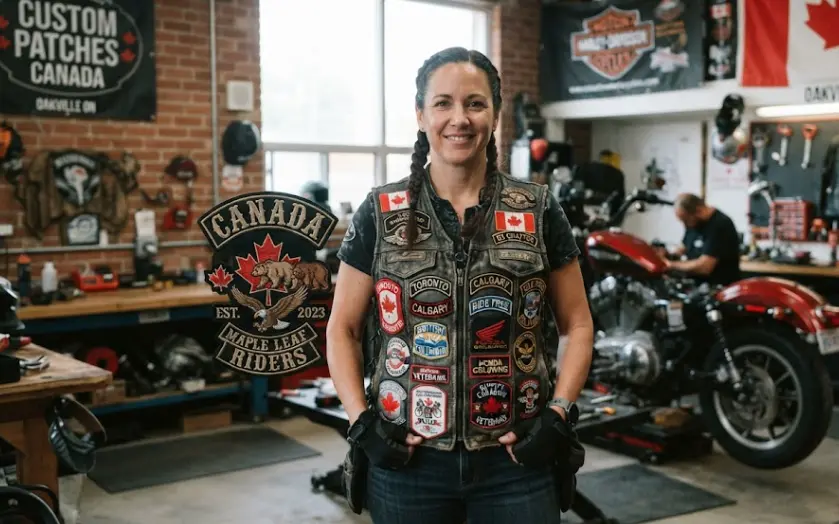
While the growl of a big V-twin engine can announce a biker from two blocks away, it is the leather vest that really tells the story. For decades, the designs stitched onto the backs of riders across Canada have spoken to brotherhood, loyalty, and territory long before a single word is exchanged.
Understanding motorcycle club patches Canada wide means stepping into a subculture built on rigid tradition, fierce independence, and a code of respect that outsiders rarely see up close. From coast to coast, these patches offer a rare glimpse into a closely guarded lifestyle, one shaped as much by Canadian history as anything happening south of the border.
History of Motorcycle Club Patches in Canada
The story of motorcycle club patches begins in the years immediately following the Second World War. Veterans who missed the adrenaline and camaraderie of service picked up cheap, surplus military motorcycles and started riding together in loose groups, mostly for the thrill of it.
At first, these riders simply wore matching gear or customized leather jackets to set their group apart from the next one. As informal riding crews grew into organised clubs, the need for a shared visual identity followed close behind, and the first true club emblems were born.
Canada developed its own chapter of this story fairly quickly. Motorcycle clubs took root across Ontario, Quebec, and British Columbia through the 1960s and 1970s, and patches became the accepted way to show which club a rider belonged to and which territory that club controlled.
The most significant chapter in Canadian biker history is the Quebec Biker War, a violent conflict through the 1990s between the Hells Angels and the Rock Machine over control of the drug trade in Quebec. The conflict resulted in more than 150 deaths, including the tragic death of an eleven-year-old boy in 1995, and pushed the federal government to introduce new criminal organization laws.
Those laws, found in sections 467.11 to 467.13 of the Criminal Code of Canada, specifically target participation in and benefiting from a criminal organization. The Royal Canadian Mounted Police, through the Criminal Intelligence Service Canada, continues to track outlaw motorcycle gang activity as a distinct category of organized crime across the country.
The Hells Angels Motorcycle Club (HAMC) operates chapters in Ontario, Quebec, British Columbia, and other provinces and remains the largest and most recognizable outlaw motorcycle club in Canada. Members are closely associated with Harley Davidson motorcycles, and law enforcement continues to link certain chapters to the drug trade and conflicts with rival clubs, including Bandidos and other Quebec-based groups.
What Is a 3-Piece Patch?
Within the tightly structured world of outlaw bikers, the three-piece patch is the highest honour a member can wear. It marks full, earned membership in a traditionally organized motorcycle club, not something handed out casually.
Wearing a full set of custom embroidered patches is earned only after years of dedication, sacrifice, and proven loyalty to the club.
Each element of the set carries its own weight. The top piece, known as the “top rocker,” displays the club name in large lettering. The centre piece shows the club logo or crest. The bottom rocker names the specific territory the chapter controls, whether that is a city, a province, or a region.
A small square patch reading “MC” often appears alongside the main set, confirming the group is a traditional motorcycle club rather than a casual riding association. Before earning the right to wear the full three-piece set, a rider typically spends time as a “prospect,” proving themselves to full patch members.
What Is the 1% Patch?
Few symbols in biker culture carry as much weight as the diamond-shaped 1% patch. Its origin dates back to the aftermath of a notorious 1947 motorcycle rally riot in Hollister, California, an event that received heavy press coverage across North America, including in Canadian newspapers of the time.
Following the incident, the American Motorcyclist Association reportedly stated that 99 percent of motorcyclists were law-abiding citizens and that only one percent caused the trouble associated with the sport.
Rather than take offence, outlaw riders embraced the label. Wearing the 1% patch became a way of declaring that club rules and brotherhood came before any law or social expectation placed on ordinary citizens.
Today, the patch signals membership in an outlaw motorcycle club specifically, distinguishing these groups from the thousands of law-abiding riding clubs across Canada. Wearing a 1% patch without belonging to a recognised outlaw club is treated as a serious act of disrespect within the community and can carry real consequences for the person wearing it.
What Does the 81 Patch Mean?
Numeric codes are common throughout biker culture, and the number 81 is one of the most recognised worldwide, including across Canada.
The code works on a simple substitution: the eighth letter of the alphabet is H, and the first letter is A. Together, 81 stands for Hells Angels. This numeric shorthand lets supporters and associates reference the club without using the protected Death Head crest, which is reserved strictly for full-patch members.
The number 81 appears on clothing, hats, and support gear worn by friends, family, and associates of the club. Wearing an 81 support patch is a public statement of loyalty to, and financial support for, the local Hells Angels chapter.
AFFA Patch Meaning Explained
Permanent loyalty sits at the core of every traditional outlaw motorcycle club, and the AFFA patch captures that idea directly. The letters stand for “Angels Forever, Forever Angels.”
By wearing this patch on a leather cut, a member is making a public and lifelong commitment to the brotherhood. For these members, club life is not a weekend hobby; it is a permanent identity.
Unlike casual riding club patches, this pledge is treated as unconditional. Every fully patched Hells Angels member understands the weight of the commitment the moment the patch goes on.
The oath behind AFFA places the brotherhood above nearly everything else, including, in many documented cases, family relationships. That level of devotion is part of what gives the patch its cultural weight, both inside and outside the club.
What Is the Filthy Few Patch?
Some patches in this subculture carry darker legends than others, and the Filthy Few patch is one of the most notorious.
Based on Canadian and American law enforcement investigations, undercover operations, and statements from former members over the years, this patch has been linked to individuals accused of committing extreme acts of violence on behalf of the club.
Within the club, it is treated as a mark of extreme loyalty and willingness to cross serious lines for the group. The exact criteria for earning it are known only within the inner circle of the club.
Whether myth or documented fact in any given case, the patch is designed to create an immediate impression of fear and respect among rivals, law enforcement, and the general public alike.
Dequiallo Patch: Origins and Reported Meaning
Another patch tied to defiance and resistance is the Dequiallo patch. The term traces back to the old military concept of “no quarter,” meaning no mercy shown and no prisoners taken.
Among outlaw clubs, this patch is reportedly given to a member who has physically resisted arrest or fought with police rather than surrender.
The message behind it is direct: a member wearing this patch is signalling that they will not yield to police authority and are prepared to accept serious consequences to protect their pride and their club’s reputation.
For law enforcement, including officers with the RCMP or provincial police services, spotting this patch on a vest is treated as a signal that the wearer may present an elevated risk during an encounter.
Other Notable Patches: Nomad, Officer Titles, and DILLIGAF
A member’s vest often works like a résumé, telling a fuller story of status, role, and personality within the club. One of the most respected statuses a rider can hold is that of a nomad.
Unlike regular members, whose bottom rocker names a specific city or province, a Nomad’s vest simply reads “Nomad.” This signals that the member is not tied to a single chapter or location and instead handles club business on a national, or even international, scale.
Officer titles worn on the front chest establish the chain of command during rides, meetings, and public events. Patches reading “President,” “Vice President,” “Secretary,” “Treasurer,” or “Sergeant at Arms” are common across Canadian chapters, mirroring the structure used by clubs worldwide.
The sergeant at arms typically handles internal discipline and physical security for the club. Beyond official titles, many riders personalize open space on their vests with acronyms reflecting their own outlook, and DILLIGAF, short for “Do I Look Like I Give A F***,” remains a well-known example of that unapologetic biker humour.
The Role of Patches in Motorcycle Club Culture
To understand why these patches matter so much, it helps to see them as more than clothing. Within a club, patches represent a member’s history, sacrifices, and standing among brothers.
Colours are treated with genuine reverence. A member’s vest is never allowed to touch the ground, and no outsider is permitted to touch a member’s patches without clear, explicit permission.
Disrespecting a club’s patches is treated as an attack on the entire group and typically brings an immediate response. That level of devotion helps maintain strict internal discipline and a strong sense of unity.
Across the country, from small-town Ontario chapters to established clubs in Quebec and British Columbia, this visual language of respect and loyalty holds the same meaning, regardless of province or dialect.
Custom Motorcycle Patches vs Club Patches
It is worth being clear that outlaw clubs guard their three-piece set closely, while the broader Canadian riding community relies just as heavily on custom embroidery to express pride in the open road. Knowing the difference matters, especially for new riders.
Independent riders, charity organizations, and casual weekend riding groups across Canada regularly order high-quality custom biker patches to commemorate rallies, honour fallen friends, or simply show off some personal style. Explore the patch types for biker clubs and riding groups before placing an order.
Velcro patch backing makes it easier to swap patches, and expressing yourself through your biker vest becomes easier. These groups generally avoid the three-piece format and the “MC” designation altogether, since using them without permission can be read as a direct challenge to an established territorial club. Understanding which motorcycle patch styles to avoid helps protect casual riders from unwanted trouble with established clubs in their region.
If you are planning a design for your own riding association, a charity ride such as those supporting local Legion branches or Ride for Dad chapters, or simply a personal leather vest, our team can help.
At Patch Makers Canada, we build strong, road-ready custom leather patches and PVC patches without stepping on established club traditions in any way. Whether you need a large centre patch for a local riding club or a small, funny phrase for the front of a vest, we can build it.
Frequently Asked Questions
Is it legal to wear a Hells Angels support patch in Canada?
Yes. Wearing official support merchandise, such as items displaying the number 81 or common support slogans, is legal in Canada and simply signals support for a local chapter. However, an individual who is not a full patch member should never wear the winged Death Head crest or otherwise present themselves as a club member, as this is considered a serious breach of respect within the biker community and can lead to real conflict.
What happens if a Canadian club member loses their patches?
Losing one’s colours is treated as a serious dishonour in traditional motorcycle club culture across Canada. A stolen or lost vest can trigger internal consequences for the member responsible, ranging from a fine to more serious disciplinary action. Members are expected to guard their patches at all times, and failing to do so is viewed as a lack of respect toward the brotherhood.
Can any new riding group in Canada use a three-piece patch?
It is strongly discouraged. A newly formed or informal riding group that adopts a three-piece patch, particularly one with a territorial bottom rocker, risks being seen as making a direct territorial claim against an established outlaw club in that region. Informal Canadian riding groups typically stick to one-piece or two-piece patches to make clear they are not staking out any territory.
How are patches attached to a heavy motorcycle leather vest?
Because leather vests are thick and durable, standard iron-on adhesive backing is not reliable, since it can peel away during highway riding, even in cold Canadian winters. Most riders bring their leather vests to a skilled leather worker, cobbler, or tailor to have custom embroidered patches sewn on properly, ensuring they stay secure through years of riding.
Order Your Custom Motorcycle Patches in Canada Today
Whether you are organizing a weekend charity ride, outfitting a national riding club, or simply adding some rugged personal style to a favourite leather vest, the quality of your patch matters.
At Patch Makers Canada, we understand the pride, history, and durability required to build patches that hold up to Canadian roads and Canadian weather. Our team offers precise digitizing, dependable craftsmanship, and rugged materials designed to handle harsh winters, long highway stretches, and years of wear.
Do not settle for a cheap patch that fades or frays after one riding season. Bring your design to life and represent your crew with pride. Contact Patch Makers Canada today to start building your premium, road-ready motorcycle club patches Canada that riders can count on.