
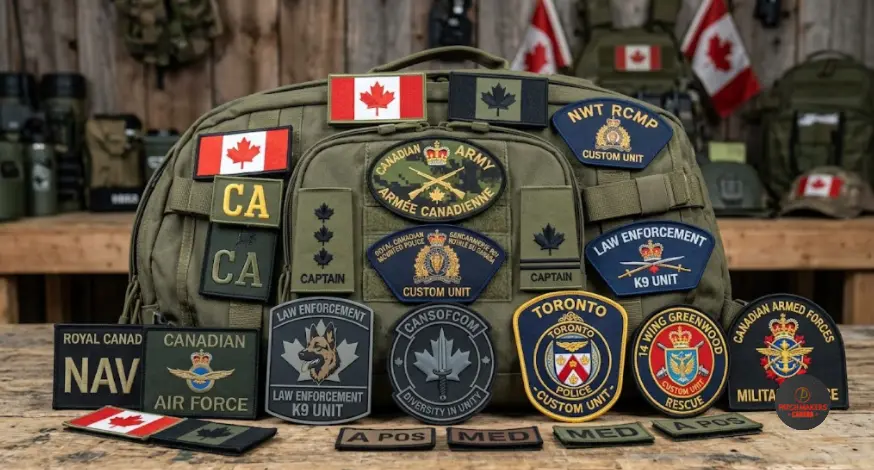
Across the Canadian Armed Forces (CAF) and Canada’s police services, a patch is never just decoration. It marks unit identity, signals rank and qualification, and carries the weight of esprit de corps that holds a team together through deployment, training, and everyday duty.
Whether stitched onto a CADPAT dress uniform or mounted on a CADPAT-MT tactical carrier, CADPAT patches/CADPAT-MT patches have to do their job in demanding field conditions while still meeting exacting regulation standards.
Custom patches for Canadian military and law enforcement uniforms are held to a higher bar than commercial merchandise. Colorfastness, abrasion resistance, regulation sizing, and backing type all matter, because a patch that fades, curls, or falls off during a training exercise is not just a cosmetic failure; it is a supply problem.
This guide walks through why units choose custom insignia, which patch types suit which uniform application, the compliance and durability factors procurement officers need to weigh, and how the ordering process works from artwork to bulk production.
For context, Canadian units operate under a distinct set of standards from their counterparts working with OCP patches in the United States or MTP patches in the United Kingdom.
While the underlying manufacturing techniques overlap, colour palettes, backing conventions, and approval chains differ by country, which is why sourcing from a supplier familiar with Canadian uniform policy matters.
Why Military & Law Enforcement Units Choose Custom Patches
Unit and Squadron Identity
Regimental patches or squadron patches are one of the clearest visual markers of belonging in the CAF. It distinguishes one unit from another at a glance, reinforces the chain of command, and gives members of a squadron, battalion, or detachment a shared symbol tied to their specific history and mandate.
Rank, Qualification Badges, and Jump Wings
Beyond unit identity, patches communicate individual achievement and role. Qualification badges, jump wings, and rank or rate insignia are functional communication tools worn on the uniform itself, allowing supervisors and peers to identify capability and standing without needing paperwork.
Task Force, K9 Unit, Tactical Team, and Special Detachment Insignia
Specialty teams, including K9 units, tactical response teams, and joint task forces, often need RCMP patches that are distinct from standard-issue patches. These groups tend to require subdued or low-visibility colorways suited to tactical gear, along with backing options that allow quick swapping between kit configurations.
Memorial and Commemorative Patches
Patches also carry meaning beyond active duty. Memorial patches honouring fallen officers or service members and commemorative patches marking unit anniversaries or significant operations are common requests from regimental associations and detachments wanting a lasting, wearable tribute.
Patch Types Best Suited for Military & Police Uniforms
Different uniform applications call for different patch construction. Choosing the right type up front avoids reorders and compliance issues down the line with law enforcement and military patches.
Embroidered Patches
Embroidered patches remain the standard for traditional dress uniforms and ceremonial wear. The raised thread detail gives a formal, high-quality finish appropriate for parade dress, mess kit, and other occasions where appearance and tradition carry weight.
PVC and Rubber Patches
PVC patches are built for tactical gear, plate carriers, and outerwear that see field use. The moulded rubber construction is weatherproof, resistant to fraying, and holds up under repeated exposure to rain, mud, and abrasion in a way embroidery cannot match.
Hook-and-Loop (Velcro) Backing
For modular tactical applications, Velcro hook-and-loop backing allows patches to be swapped between vests, bags, and uniforms quickly. This is especially useful for units that rotate personnel across roles or need to change identifiers for different operations without re-issuing gear.
Woven Patches for Fine Detail
Where a design includes fine text, a detailed crest, or a motto that would blur under standard embroidery, woven patches offer a tighter weave that renders small lettering and intricate heraldry more clearly.
Subdued and Tactical Colours vs. Full-Colour Dress Patches
Field and tactical patches are frequently produced in subdued colorways, muted greens, browns, and blacks that reduce visibility in operational settings. Full-colour patches remain appropriate for dress uniforms, ceremonial functions, and public-facing roles where visibility and presentation are the priority.
Compliance and Durability Considerations
Meeting CAF Dress Instructions and Police Uniform Policy
CAF dress instructions and municipal or provincial police uniform policies set specific requirements for patch placement, sizing, and design elements. Procurement officers and unit commanders ordering custom insignia need production that can be matched precisely to these specifications, since even small deviations in size or colour can result in a rejected batch.
Colorfastness and Abrasion Resistance
Patches worn in the field face sun exposure, repeated laundering, and physical wear. Colorfastness and abrasion resistance are not optional features for military and police applications; they determine whether a patch still looks correct after months of active use rather than fading or fraying within weeks.
Backing Options: Sew-On vs. Velcro vs. Iron-On
Backing choice affects both durability and compliance. Sew-on backing offers the most permanent, secure attachment and is standard for dress uniforms. Velcro backing supports modular tactical use. Iron-on backing, while convenient, is generally not suitable for uniforms that undergo frequent laundering or rigorous field use, and some units prohibit it outright.
Note: Exact specifications vary by branch, service, and detachment. Units should confirm sizing, colour, and backing requirements with their quartermaster or uniform policy documentation before placing an order.
Common Use Cases in Canada
- CAF regimental and squadron patches for army, navy, and air force units across postings
- RCMP detachment and specialty unit patches, including K9, tactical, and community policing teams
- Municipal police division and unit patches for services in cities such as Toronto, Vancouver, and Calgary
- Corrections and border services patches for CBSA and correctional facility personnel
- Veterans’ associations and Legion branch patches for commemorative and ceremonial use
How to Order: Design, Approval, and Bulk Production
Submitting Insignia and Crest Artwork
Ordering starts with submitting existing insignia artwork or a description of the design, including any regimental heraldry elements that need to be reproduced accurately. Units with established crests should provide official artwork files where available to ensure colours, proportions, and symbolic elements are preserved correctly.
Proof and Approval Process
Before production begins, a digital proof is provided for review. This step allows procurement officers and commanding officers to confirm sizing, colour matching, and design accuracy against unit standards before committing to a full production run.
Bulk Ordering for Full Units and Detachments
Most military and police orders involve outfitting an entire unit or detachment rather than individual members. Bulk ordering ensures consistency across every patch in a batch, which matters for units that need identical insignia across dozens or hundreds of uniforms.
Typical Turnaround Times
Production timelines depend on order size, patch type, and design complexity, with rush production available for time-sensitive needs such as upcoming ceremonies or deployment schedules. Units working against a fixed date should flag the timeline requirement at the time of quote request.
Why Choose Patch Makers Canada
Patch Makers Canada operates with direct experience serving Canadian government, military, and law enforcement clients, understanding the specific compliance and durability expectations these orders carry.
Every order goes through a quality assurance process built around regulation accuracy, not just visual appeal, so units can trust that patches meet the standard their uniform policy demands.
For units with ongoing or recurring needs, bulk pricing and reorder consistency mean a detachment or regiment can return for future batches with confidence that patch colour, sizing, border, backing, and construction will match previous orders exactly. That consistency matters over years of service, as units expand, rotate personnel, or update Canadian custom military patches.
Frequently Asked Questions
What is the difference between embroidered and PVC patches for uniform use?
Embroidered patches use raised thread stitching to create a traditional, textured finish suited to dress uniforms, mess kit, and ceremonial wear where appearance and formality matter most. PVC patches, by contrast, are moulded from durable rubber-like material and are built specifically for field and tactical use. They resist water, mud, and abrasion far better than embroidery, which makes them the preferred choice for plate carriers, outerwear, and any gear exposed to harsh conditions.
Can Patch Makers Canada match official regimental colours and heraldry exactly?
Yes, colour and heraldry matching is a core part of the production process for military and police orders. Units can submit official artwork files, colour codes, or existing patch samples, and the proof stage is used specifically to confirm that colours, proportions, and any heraldic elements are reproduced accurately before full production begins. Regimental crests often include specific symbolic details, mottos, or historical elements that need careful attention during digitizing, so submitting the most complete reference material available helps avoid revisions.
What backing type is recommended for tactical gear versus dress uniforms?
Hook-and-loop (Velcro) backing is generally recommended for tactical gear because it allows patches to be swapped quickly between vests, bags, and modular uniform components without needing to re-stitch anything. Dress uniforms, on the other hand, typically call for sew-on backing, which provides a permanent, secure attachment appropriate for formal and garrison wear that is not regularly reconfigured.
How long does a bulk order take to produce for a full unit or detachment?
Turnaround time depends on the size of the order, the patch type selected, and the complexity of the design, with embroidered and woven patches generally taking longer to produce than PVC due to the stitching process involved. Standard bulk orders for a full unit or detachment typically require several weeks from proof approval to completed production, though this window narrows or widens based on order volume.
Request a Quote for Your Unit
Procurement officers, unit commanders, and association leads can request a quote for custom patches for Canadian military or law enforcement patches directly through Patch Makers Canada. Submit your unit’s artwork or design details for a proof and pricing, whether the order is a one-time run or an ongoing supply arrangement.
Time-sensitive orders tied to ceremonies, promotions, or deployment schedules can be accommodated through rush production. Contact our expert team today to get your free custom quote.